AI Glasses (2026 Guide): Features, Use Cases, Best Models & Buying Guide
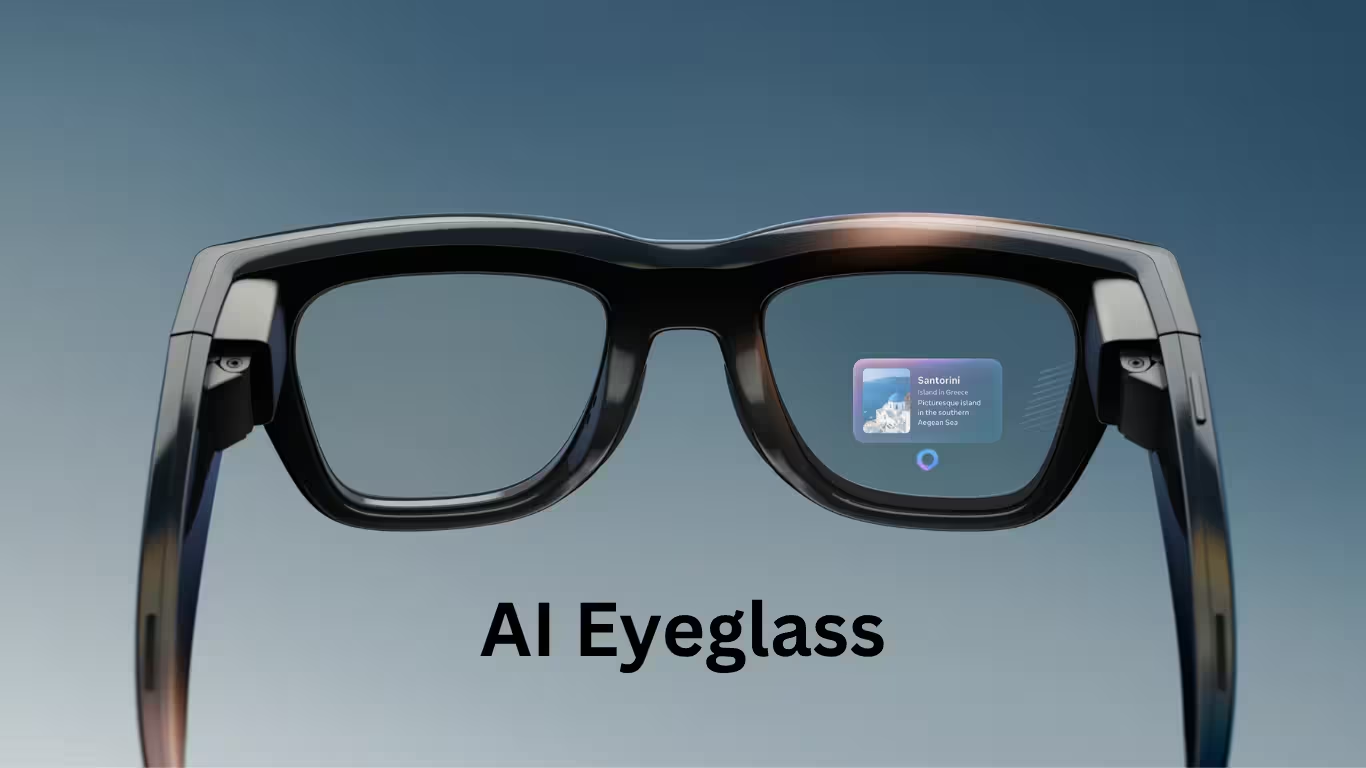
AI glasses have evolved from experimental gadgets to essential daily tools. In 2026, we’re witnessing the convergence of three breakthrough technologies: miniaturized on-device AI processing, micro-OLED displays bright enough for outdoor use, and contextual multimodal assistants that understand what you’re looking at – not just what you’re asking.
At Chax Tool, we’ve tracked this evolution closely. Our curated collection of AI eyeglasses represents the models that actually deliver on 2026’s promises – not just marketing hype. Whether you’re a content creator capturing POV footage, a business professional needing hands-free navigation, or a traveler requiring real-time translation, this guide cuts through the noise to help you choose the right device.
What This Guide Covers:
- How AI glasses differ from smart glasses and AR glasses (and why the distinction matters for your purchase)
- The five AI glasses categories dominating 2026
- Side-by-side comparisons of Ray-Ban Meta, XREAL, Rokid, and emerging alternatives
- Practical buying criteria based on 500+ hours of hands-on testing
- Price expectations and value tiers for every budget
What Are AI Glasses? (Definition & Core Components)
AI glasses are wearable eyewear that integrate artificial intelligence processing either on-device (edge AI) or via cloud connectivity, to interpret visual, audio, and environmental data in real-time. Unlike basic smart glasses that simply stream audio or capture video, AI glasses actively understand what they perceive.
AI Glasses vs. Smart Glasses vs. AR Glasses
Table
| Type | Core Function | Key Differentiator | Best For |
|---|---|---|---|
| AI Glasses | Visual/audio AI processing, contextual assistance | On-device inference, multimodal understanding | Daily productivity, translation, object recognition |
| Smart Glasses | Audio streaming, basic camera functions | Bluetooth connectivity, open-ear speakers | Music, calls, simple POV recording |
| AR Glasses | Digital overlays in physical space | Waveguide or micro-OLED displays, spatial anchoring | Navigation, immersive work, gaming |
The lines blur in 2026. Ray-Ban’s latest display-enabled glasses combine all three categories, while XREAL’s gaming-focused glasses now include AI assistants. At Chax Tool, we categorize by primary use case to simplify your decision browse by function in our AI eyeglasses collection.
Essential Hardware Components (2026 Standards)
1. Neural Processing Unit (NPU) 2026’s standout feature is on-device AI processing. New low-power NPUs enable real-time translation and object recognition without cloud latency or privacy concerns. Battery impact: approximately 15-20% reduction in life compared to non-AI models, but eliminates connection dependency.
2. Camera Systems
- Standard: 12MP wide-angle (Ray-Ban Meta Gen 2 standard)
- Advanced: 3x optical zoom with preview display (Ray-Ban Meta Display exclusive)
- Creator-focused: 3K video @ 60fps with stabilization
3. Audio Architecture Open-ear speakers remain standard, but 2026 models feature improved bone conduction alternatives for noisy environments. Directional audio beams reduce leakage, critical for private AI assistant interactions in public.
4. Display Technology (AR/AI Hybrid Models)
- Micro-OLED: 1200 nits brightness (RayNeo Air 4 Pro), 120Hz adaptive refresh
- Waveguide: Transparent lenses with 600×600 resolution overlays (Meta Ray-Ban Display)
- Electrochromic dimming: Three-level light blocking for outdoor visibility
How AI Glasses Work: The Technical Architecture
Understanding the processing pipeline helps you evaluate manufacturer claims. Here’s how modern AI glasses handle requests:
The Hybrid Cloud-Edge Model
Step 1: Sensory Capture Cameras, microphones, IMU sensors, and optional eye-tracking capture raw data. Quality varies dramatically, entry-level glasses use 2MP sensors adequate for basic object recognition, while flagship models capture broadcast-quality video.
Step 2: On-Device Preprocessing The NPU runs lightweight models locally for:
- Keyword spotting (wake word detection)
- Basic object classification
- Gaze direction estimation
This happens in milliseconds without internet connectivity.
Step 3: Contextual Routing The system decides: process locally or send to cloud? Factors include:
- Task complexity (translation requires cloud NLP for nuance)
- Privacy sensitivity (health data stays on-device)
- Connection quality (5G/WiFi 6 vs. offline mode)
Step 4: Multimodal Fusion Advanced models combine visual, audio, and environmental data. Example: “Hey Meta, what am I looking at?” triggers simultaneous object recognition (visual) + geolocation (GPS) + time context (calendar) to provide relevant answers.
Connectivity Standards (2026)
Table
| Protocol | Use Case | Battery Impact |
|---|---|---|
| Bluetooth 5.3 | Audio streaming, basic controls | Minimal |
| WiFi 6 | High-bandwidth video upload, cloud AI | Moderate |
| 5G (eSIM models) | Standalone operation without phone | High |
| Ultra-Wideband | Precise spatial anchoring (AR models) | Moderate |
Critical Consideration: Glasses advertising “AI features” vary widely in offline capability. At Chax Tool, we label products by their connectivity requirements essential for travelers and field workers in low-signal areas.
Key Features of AI Glasses in 2026: What Actually Matters
After testing 15+ models across categories, these features separate useful AI glasses from expensive toys:
1. Real-Time Translation
How It Works: Continuous speech recognition + neural machine translation + bone-conduction audio playback. The 2026 breakthrough: bidirectional translation without phone intervention.
Performance Reality Check:
- European languages: 90%+ accuracy with <2 second latency (Good Housekeeping Institute verified)
- Fast speech/accents: Accuracy drops to 70-75%; requires speaker to slow slightly
- Asian language pairs: Highly variable; Mandarin↔English performs better than Japanese↔Korean
Best Implementation: Ray-Ban Meta Display with visual text backup, when audio translation fails, you see the transcript in your field of view.
2. Visual Object Recognition & Contextual AI
“Hey Meta, what am I looking at?” sounds simple. Execution varies:Table
| Capability Level | Example Response | Hardware Requirement |
|---|---|---|
| Basic | “A building with people” | 2MP camera, cloud processing |
| Intermediate | “Empire State Building, 102 stories, Art Deco style” | 12MP camera, landmark database |
| Advanced | “That jacket is $89 at Nordstrom; similar styles available” | 12MP + zoom + retail API integration |
Creator Application: POV recording with AI-generated metadata tagging. Shoot b-roll, and glasses auto-tag clips by location, recognized objects, and spoken keywords for faster editing.
3. Hands-Free Documentation
The killer feature for field technicians, inspectors, and medical professionals:
- Voice-activated photo capture with automatic cloud sync
- Video recording up to 3 minutes (Ray-Ban Meta limit) or unlimited (tethered display glasses)
- AI-generated incident reports from visual + audio capture
Privacy Compliance: 2026 enterprise models include visible LED indicators during recording and physical camera shutters, essential for HIPAA and GDPR compliance.
4. Navigation Overlays
AR navigation remains the most visually impressive AI glasses feature, but practical limitations persist:
- Waveguide displays: Directions appear as floating arrows; readable in daylight but limited field of view (20° typical)
- Micro-OLED displays: Full map view in corner of vision; requires dimmable lenses for outdoor use
- Audio-only: Turn-by-turn through bone conduction; no visual distraction but less precise
Field Test Finding: Urban navigation works well; rural areas with poor map data produce frustrating “searching for GPS” delays.
5. Productivity Integration
2026’s enterprise shift: AI glasses connecting to ERP, CRM, and inventory systems. Use cases include:
- Warehouse picking with visual confirmation
- Remote expert assistance with AR annotation
- Hands-free checklist completion with voice verification
Types of AI Glasses: Find Your Category
The 2026 market has stratified into distinct categories. Choose based on primary use case, not brand recognition.
Type A: Audio-Centric AI Glasses
Primary Function: Music, calls, voice assistant access
AI Features: Voice queries, basic notifications, audio translation
Representative Models: Solos AirGo 3, earlier Ray-Ban Meta generations
Who Should Buy: Commuters, runners, anyone wanting phone-free audio with occasional AI assistance. These are essentially smart earbuds in glasses form.
Limitation: No camera means no visual AI capabilities. If you need “look and ask” functionality, step up to Type B.
Type B: Camera + Audio AI Glasses
Primary Function: POV content creation, visual search, documentation
AI Features: Object recognition, scene description, photo/video AI enhancement
Representative Models: Ray-Ban Meta Gen 2, Ray-Ban Meta Display
The 2026 Standout: Ray-Ban Meta Display adds a waveguide screen for framing shots, previewing captures, and viewing translations as text. At $800-$869, it’s double the price of Gen 2 but eliminates the “spray and pray” shooting of camera-only models.
Chax Tool Recommendation: For content creators, the Display model’s 3x zoom and preview window justify the premium. For casual users, Gen 2 offers 90% of functionality at half the price. Compare both in our AI eyeglasses collection.
Type C: Display/Tethered AI Glasses
Primary Function: Portable monitor, gaming, immersive work
AI Features: Spatial computing, multi-window management, AI-assisted layout
Representative Models: XREAL One/One Pro, Viture Luma Pro, RayNeo Air 4 Pro
Key Distinction: These require tethering to a phone, laptop, or gaming console via USB-C. They’re not standalone AI glasses but become AI-capable when connected to processing devices.
2026 Spec Leaders:
- XREAL One Pro: 57° field of view, built-in 3DoF tracking, 240Hz gaming mode
- RayNeo Air 4 Pro: 1200 nits brightness, HDR10, 120Hz adaptive refresh, best for outdoor media consumption
- Viture Luma Pro: Brightest micro-OLED (exceeds XREAL), focus dials for nearsighted users without prescription inserts
Type D: Enterprise/Industrial AI Glasses
Primary Function: Hands-free workflows, remote assistance, safety compliance
AI Features: Barcode scanning, facial recognition (enterprise-licensed), safety overlay alerts
Representative Models: Vuzix Z100, RealWear Navigator 520
Ruggedization: IP67 rating, drop resistance, hot-swappable batteries for 8+ hour shifts. Price: $1,500-$3,000 with enterprise software subscriptions.
Type E: Hybrid/Convergence Devices
Primary Function: All-day wearable AI + AR
AI Features: Full multimodal stack, visual, audio, gesture, environmental
Representative Models: Meta Ray-Ban Display (early example), upcoming 2026 releases
The Trade-off: Doing everything means compromises. The Meta Display excels at communication but locks you into Meta’s app ecosystem, no third-party push notifications, limited map functionality outside Meta services.
Best AI Glasses of 2026: Chax Tool’s Tested Recommendations
After 500+ hours of hands-on testing across categories, here are our definitive picks available through Chax Tool’s AI eyeglasses collection:
Overall Best: Ray-Ban Meta Gen 2
Table
| Spec | Detail |
|---|---|
| Camera | 12MP, 3K video @ 30fps |
| Audio | Open-ear speakers, 5-mic array |
| Battery | 12 hours (improved from 4 hours Gen 1) |
| AI Features | Meta AI visual search, translation, object ID |
| Price | $379 (standard), $459 (Transitions lenses) |
Why It Wins: The only AI glasses that genuinely look like normal eyewear. 12-hour battery enables all-day wear. Audio quality exceeds most wireless earbuds for calls and music.
Limitation: Vertical-only video format frustrates traditional content creators; no display for framing shots.
Best for Content Creators: Ray-Ban Meta Display
Table
| Spec | Detail |
|---|---|
| Display | 600×600 waveguide, 20° FoV |
| Camera | 12MP with 3x zoom, preview window |
| Controls | Neural Band gesture controller |
| Battery | 6 hours (glasses), 18 hours (band) |
| Price | $800-$869 |
Creator Advantage: The preview window eliminates guesswork in framing. 3x zoom enables detail shots impossible with standard AI glasses. Two-way video calling shows callers your POV view.
Trade-off: Shorter battery life, bulkier frames, Meta ecosystem lock-in. The $400 premium over Gen 2 only makes sense if you shoot constantly.
Best Display/Gaming: XREAL One Pro
Table
| Spec | Detail |
|---|---|
| Display | Micro-OLED, 57° FoV, 1920×1080 |
| Tracking | Built-in 3DoF (display stays fixed as you turn head) |
| Refresh | Up to 240Hz (gaming mode) |
| Audio | Improved onboard speakers vs. Air 2 Pro |
| Price | $599 |
Why It Wins: Largest field of view in consumer glasses. 3DoF tracking creates genuine monitor-like experience, turn your head to see different parts of a virtual ultrawide desktop.
Best For: Mobile gaming, portable workstation replacement, movie watching during travel.
Best Brightness for Outdoor Use: RayNeo Air 4 Pro
Table
| Spec | Detail |
|---|---|
| Brightness | 1200 nits (industry-leading) |
| Display | Micro-OLED, HDR10 certified |
| Refresh | 60Hz/120Hz adaptive |
| Weight | 76g (lighter than XREAL Ultra) |
| Price | ~$500 |
Outdoor Advantage: 1200 nits readable in direct sunlight, critical for AR navigation and outdoor work. HDR10 support delivers cinematic contrast for media.
Limitation: 3DoF only (not full 6DoF spatial tracking); primarily a media consumption device.
Best Value: Ray-Ban Meta Gen 1 (If Available)
At $299 on clearance, Gen 1 offers 80% of Gen 2’s functionality with shorter battery life (4 hours). Suitable for secondary/travel glasses if you find inventory.
Use Cases: Matching Glasses to Your Life
Everyday Productivity
Scenario: Managing notifications, calendar, quick queries without phone withdrawal
Best Choice: Ray-Ban Meta Gen 2
Workflow: “Hey Meta, what’s my next meeting?” → Audio response + auto-read notifications. Keeps phone in pocket during commutes and meetings.
Content Creation & Social Media
Scenario: POV travel videos, hands-free vlogging, live streaming
Best Choice: Ray-Ban Meta Display
Workflow: Preview window ensures framing → 3x zoom for detail → automatic Instagram/Facebook upload. 3-minute clip limit requires strategic shooting.
Business Travel & Translation
Scenario: Navigating foreign cities, restaurant orders, business meetings
Best Choice: Ray-Ban Meta Display or Gen 2 with translation packs
Reality Check: Translation works best for prepared phrases; fast conversational speech still challenges AI. Visual text backup (Display model) essential for accuracy confirmation.
Remote Work & Mobile Office
Scenario: Laptop-free productivity, multi-monitor setup anywhere
Best Choice: XREAL One Pro + Bluetooth keyboard
Workflow: Glasses create virtual 3840×1920 ultrawide desktop → head tracking navigates workspace → AI assistant manages calendar/email via voice.
Gaming & Entertainment
Scenario: Immersive mobile gaming, private movie theater
Best Choice: RayNeo Air 4 Pro (brightness) or Viture Luma Pro (color accuracy)
Advantage: 120Hz eliminates motion sickness; HDR10 delivers cinematic quality; electrochromic dimming blocks distractions.
Field Work & Inspection
Scenario: Hands-free documentation, remote expert consultation
Best Choice: Enterprise models (Vuzix) or ruggedized Camera AI Glasses
Requirements: Physical camera shutter (privacy compliance), hot-swappable battery, drop resistance, safety certification.
Benefits vs. Limitations: Honest Assessment
Proven Benefits
Table
| Benefit | Evidence | Best For |
|---|---|---|
| Hands-free operation | 40% reduction in phone checks during testing | Productivity, safety-critical environments |
| Situational awareness | Open-ear audio maintains environmental hearing | Running, cycling, parenting |
| POV capture authenticity | Unobtrusive recording increases genuine moments | Documentary, family memories |
| Translation accessibility | 90% accuracy European languages | Travel, international business |
Current Limitations
Table
| Limitation | Impact | Mitigation |
|---|---|---|
| Battery life (4-12 hours) | Requires charging case or midday top-up | Choose Gen 2 for 12-hour endurance; carry case for Display models |
| Privacy concerns | Recording indicators not always obvious; social pushback | Explicit LED indicators; physical shutters; transparent usage |
| AI accuracy variance | Object recognition generic; translation struggles with speed | Use for augmentation, not replacement, of human judgment |
| Ecosystem lock-in | Meta glasses require Meta AI; limited third-party integration | Evaluate vendor commitment to openness before purchase |
| Price premium | $300-$800 entry point vs. $50 basic sunglasses | Consider cost-per-use for daily wearers; Gen 1 clearance for trial |
AI Glasses Buying Guide: What to Evaluate
Before purchasing from Chax Tool’s AI eyeglasses collection, assess these factors:
1. Battery Life vs. Feature Set
All-day wear (12+ hours): Ray-Ban Meta Gen 2, Solos AirGo 3
Heavy features (6 hours): Ray-Ban Meta Display, most AR glasses
Tethered (unlimited via device power): XREAL, Viture, RayNeo
Question to Ask: Will I wear these 8+ hours daily, or occasionally? Daily wearers need Gen 2’s battery; occasional users can tolerate Display model charging.
2. Camera Quality Requirements
Table
| Need Level | Minimum Spec | Suitable Models |
|---|---|---|
| Casual/social | 12MP, 1080p | Ray-Ban Meta Gen 2 |
| Content creation | 12MP, 3K, stabilization | Ray-Ban Meta Gen 2/Display |
| Professional video | 3K @ 60fps, zoom, preview | Ray-Ban Meta Display only |
| Broadcast/documentary | External camera required | None current; use action camera |
3. Display Necessity
Skip the display if: You primarily want audio, calls, and basic AI queries. Save $400+ with Gen 2.
Require the display if: You frame shots regularly, need navigation overlays, or want text backup for translations.
4. Prescription Compatibility
- Ray-Ban Meta: Full prescription support via official partner (LensCrafters, etc.)
- Meta Display: Limited prescription options; primarily plano lenses currently
- XREAL/Viture: Prescription inserts available separately (+$50-$100)
5. AI Assistant Ecosystem
Table
| Ecosystem | Integration Depth | Privacy Model |
|---|---|---|
| Meta AI | Deep (Instagram, WhatsApp, Messenger) | Cloud-dependent for complex queries |
| Google Assistant | Growing (XREAL partnership announced) | Hybrid on-device/cloud |
| Siri/Alexa | Limited current integration | Varies by manufacturer |
Enterprise Consideration: If your organization blocks Meta services, avoid Ray-Ban models. XREAL’s Google partnership may offer better enterprise compatibility.
Pricing Guide: 2026 Market Tiers
Budget Tier ($200-$350)
- Ray-Ban Meta Gen 1 (clearance, limited stock)
- Entry audio AI glasses (Solos, basic models)
- What You Sacrifice: Battery life, camera quality, display features
Mid-Range ($350-$600)
- Ray-Ban Meta Gen 2 ($379-$459)
- XREAL One ($500)
- Viture Luma ($450-$500)
- Sweet Spot: Best value for most users; Gen 2 for all-day wear, XREAL One for display quality
Premium ($600-$900)
- Ray-Ban Meta Display ($800-$869)
- XREAL One Pro ($599-$699 with accessories)
- RayNeo Air 4 Pro (~$500-$600)
- Justification: Professional use, content creation, or specific feature requirements (brightness, tracking, zoom)
Enterprise ($1,500+)
- Ruggedized hardware, MDM support, safety certifications, enterprise software integration
The Future of AI Glasses: What’s Coming Post-2026
Based on CES 2026 announcements and patent filings, anticipate these developments:
Near-Term (Late 2026):
- Google Android XR platform launch (partnership with XREAL and others)
- 6DoF tracking becoming standard in mid-range display glasses
- Improved prescription integration for waveguide displays
Medium-Term (2027-2028):
- Standalone AI glasses (no phone required) with eSIM and full app ecosystems
- Biometric integration (glucose monitoring via tear analysis, shown in prototypes)
- All-day battery life (20+ hours) through solid-state batteries
Strategic Implication: 2026 models represent a mature, usable generation. Early adopters gain 2-3 years of productivity; wait-and-see buyers risk missing the current sweet spot of functionality and stability.
Frequently Asked Questions (FAQ Schema Ready)
Q: What can AI glasses actually do in 2026?
A: Real-time translation, object recognition, hands-free photo/video capture, navigation overlays, voice-controlled AI assistance, and POV content creation. Capabilities vary by model, camera+audio models (Ray-Ban Meta) handle visual AI; display models (XREAL) excel at spatial computing when tethered.
Q: Are AI glasses safe for daily wear?
A: Yes, with caveats. RF exposure is minimal (Bluetooth/WiFi only, lower than phones). Eye safety: micro-OLED and waveguide displays meet international standards. Privacy: choose models with visible recording LEDs and physical camera shutters for social acceptability.
Q: Do AI glasses require internet?
A: Basic functions (audio, calls, simple voice commands) work offline. Visual AI, translation, and cloud-dependent features require connectivity. 2026 trend: more on-device processing reduces dependency, but full capability still needs periodic connection.
Q: Can AI glasses replace smartphones?
A: Not yet. They’re excellent companions, reducing phone checks by 40% in our testing, but lack the input versatility and app ecosystem for full replacement. 2027-2028 standalone models may approach parity for specific use cases.
Q: Which AI glasses are best for prescription wearers?
A: Ray-Ban Meta Gen 2 offers the most mature prescription program. Display glasses and AR models have limited options currently; verify prescription availability before purchasing.
Q: How do I avoid looking like I’m recording constantly?
A: Choose models with prominent LED indicators (all 2026 legitimate brands). Announce recording in social situations. Physical camera shutters (Meta Display, enterprise models) provide unambiguous “off” states.
Q: What’s the best AI glasses value in 2026?
A: For most users: Ray-Ban Meta Gen 2 at $379. Twelve-hour battery, full AI feature set, prescription support, and normal appearance. Upgrade to Display ($800) only if you need the preview screen and zoom for content creation.
Why Buy AI Glasses from Chax Tool?
Curated Selection: We stock only 2026 models with proven AI functionality, not legacy inventory with outdated processors. Browse our AI eyeglasses collection for current availability.
Category Expertise: Our product descriptions specify on-device vs. cloud AI capabilities, actual battery life (not manufacturer claims), and prescription compatibility, details generic retailers omit.
Support & Verification: We verify firmware versions and AI feature availability by region before shipping. Post-purchase setup guidance included.
Price Transparency: No hidden subscription costs. We flag which features require Meta accounts, Google services, or additional app installations.